
CASE/04 / Manufacturing
IndiaOne identity for every machine, across plants of every age
An asset app issued QR labels for every machine and its components, with human review in Google Sheets and integration into the ERP and fixed asset register.
01 / THE ASK
The decision behind the brief.
A leading Indian manufacturing group needed to know, for every machine it owns, where it is, what it is made of, what condition it is in and what the books say it is worth. Some of its plants are highly automated. Others run on manual routines built up over decades. The ERP could not be configured quickly enough to capture how each plant actually tracks its machinery.
02 / WHAT WE FOUND
What the work revealed.
The facts about any one machine sat in different places with different owners. Location and stocktake status lived in local spreadsheets. Manuals and specifications sat in cabinets and shared drives. Service history stayed with each maintenance team. Finance held acquisition values and depreciation in the fixed asset register. None of these pointed to the others.
A machine also rarely runs alone. Its motor, pump or control panel can be removed for repair or held in a warehouse, and once separated it was hard to say which machine it belonged to. Waiting for every plant to reach the same level of automation was not a realistic route to control.
03 / WHAT WE BUILT
One identity per machine. Connected, not replaced.
Generate a QR identity and print the label
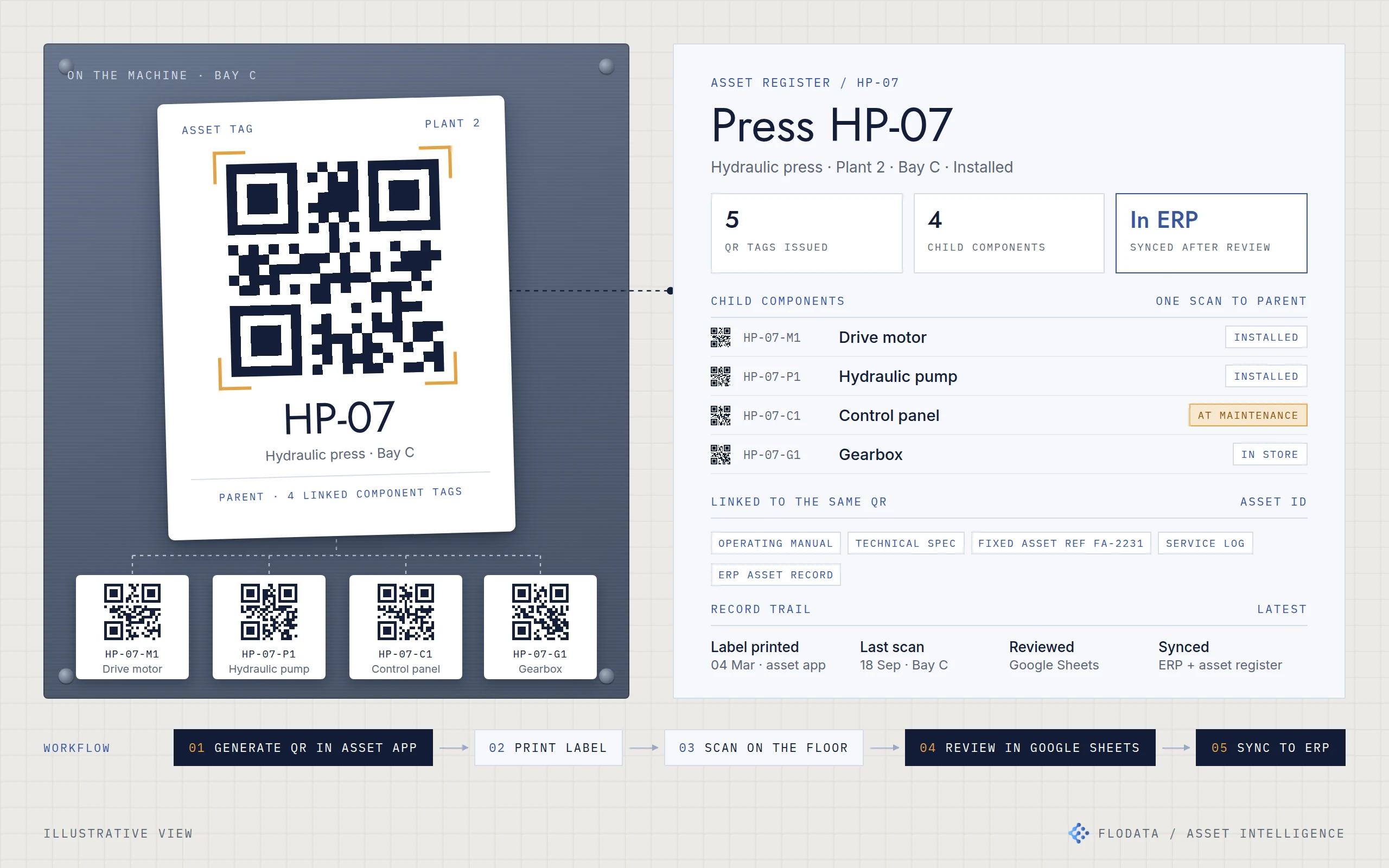
We built an asset application that registers each machine, issues it a unique asset ID and QR code and prints the label that is fixed to it. The same routine works in a modern plant and in a legacy one.
Keep the machine and its parts together
Major components such as motors, pumps and control panels carry related QR codes. Scan a component and see its parent machine. Scan the parent and see every linked component. A component stays traceable when it is installed, removed, stored or sent for maintenance.
Make stocktake a scan
Teams verify assets with a mobile app on the shop floor. Each scan is checked against the register, and results roll up from component to complete machine.
Keep people in charge of changes
New assets and exceptions go through a Google Sheets review step before they reach the central database. A component found away from its registered location is held for review, not silently overwritten.
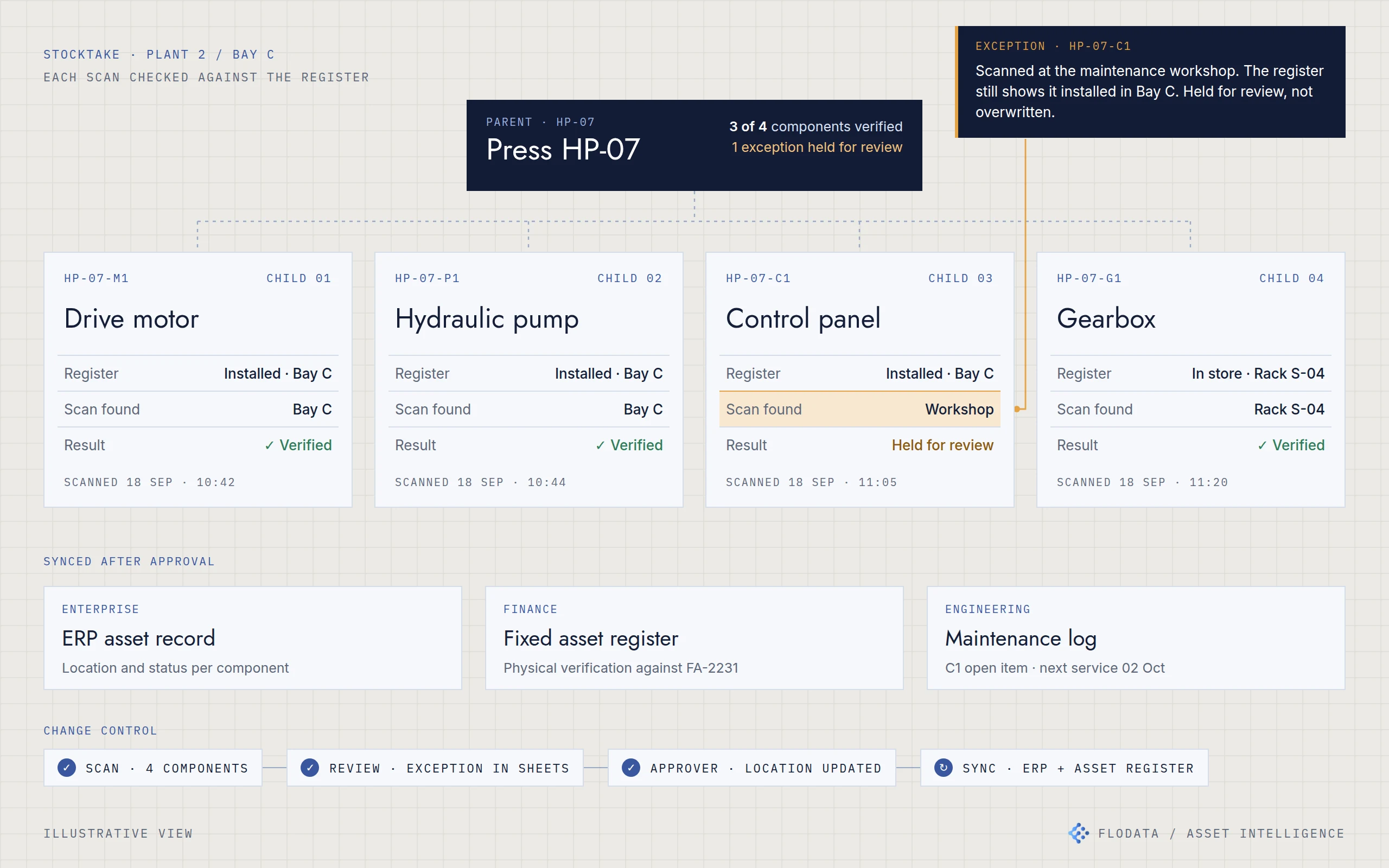
Each scan is checked against the register. A component found away from its recorded location is held for review, and the record changes only after approval.
Put the documents one scan away
Manuals and technical specifications are linked to the asset ID, so the person standing at the machine can open them from the same scan.
Integrate with the ERP
Approved records sync to the ERP and the fixed asset register, and link to maintenance records. Finance sees physical verification next to acquisition value, accumulated depreciation and written-down value from the register. Maintenance sees service frequency, last service date and next due date. Energy data is linked where a reliable source exists. [CONFIRM: whether maintenance and energy links are live or ready to switch on]
04 / THE RESULT
Control today. A foundation for what follows.
The group can now find any machine and its components, verify them in a scan, open their manuals and reconcile what was found with the fixed asset register. Every plant records machinery the same way, whatever its level of automation, and the client team runs and extends the layer without depending on us.
The same asset identity is the starting point for condition-based and predictive maintenance, energy-performance analysis and sensor data. Those are next steps the foundation now supports, not work delivered in this engagement.
05 / ENGINEERING DETAILUnder the hood
- Generate QR and print label
- Scan on the floor
- Review in Google Sheets
- Sync to ERP
- Plan maintenance
Asset application. Registers assets, generates QR codes and prints labels for machines and their components.
Asset identity. Each asset carries a unique ID and QR code, its plant, warehouse and precise location, its status (installed, loose, under maintenance or available), its condition and its last verification date.
Parent and child structure. Machines and their major components are held as related records. Stocktake results roll up from component to machine, and a component keeps its link to its parent wherever it is.
Review controls. Additions and exceptions pass through a human-reviewed Google Sheets workflow before they are written to the central operational database.
ERP integration. Approved records sync to the ERP and fixed asset register, with links to maintenance systems. Financial values are read from the fixed asset register and are not calculated by the app. [CONFIRM: database, app framework and hosting, if we want to name them]
- Asset app with QR generation and label printing
- Mobile stocktake app
- Parent and child asset structure
- Google Sheets review workflow
- ERP and fixed asset register integration