
CASE/03 / Insurance & financial services
Florida, USALife expectancy modelling for life settlements
Medical records became a structured, explainable input to life-settlement valuation.
01 / THE ASK
The decision behind the brief.
Life-settlement valuation depends partly on estimating an insured person's remaining life expectancy. The information needed to support that estimate was distributed across handwritten notes, scanned reports and structured medical records.
The requirement was to convert those records into consistent analytical inputs, produce a statistical estimate and make the influence of the underlying factors visible to the valuation team.
02 / WHAT WE FOUND
What the work revealed.
The principal challenge came before modelling. Medical histories were recorded in different formats, with inconsistent terminology, varying levels of detail and information spread across multiple documents.
A useful model required more than extracting text. Conditions, treatments, lifestyle indicators and other relevant factors had to be identified, standardised and connected to their source records. The resulting estimate also needed to remain understandable to the people using it in valuation decisions.
03 / WHAT WE BUILT
Turn complex medical records into an estimate that valuation teams can examine.
Extract and classify the record
OCR and natural-language processing identify relevant information in handwritten notes, scanned reports and structured files. Extracted content is organised into consistent medical and lifestyle categories for analysis.
Standardise the model inputs
Different descriptions of the same condition are reconciled into a common factor set. Missing or unclear information remains visible rather than being silently treated as confirmed data.
Model the estimate
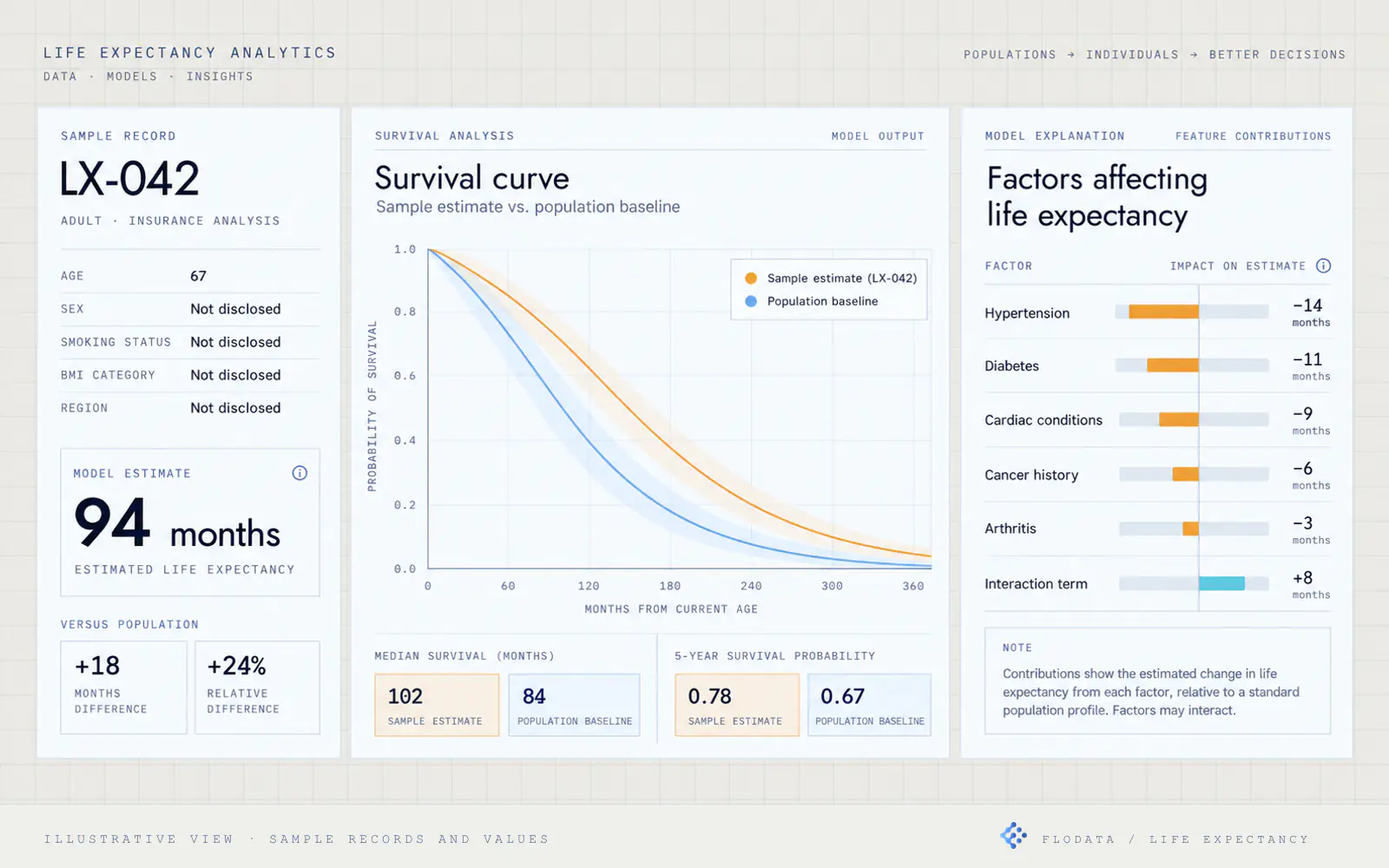
A Cox Proportional Hazards model combines the standardised factors to produce an estimated survival period. The output is presented as a statistical estimate for valuation support, not as an individual clinical prognosis.
Explain the contribution
The dashboard shows the baseline and the positive or negative contribution associated with each modelled factor. This allows a reviewer to see how the estimate was formed instead of receiving only a final number.
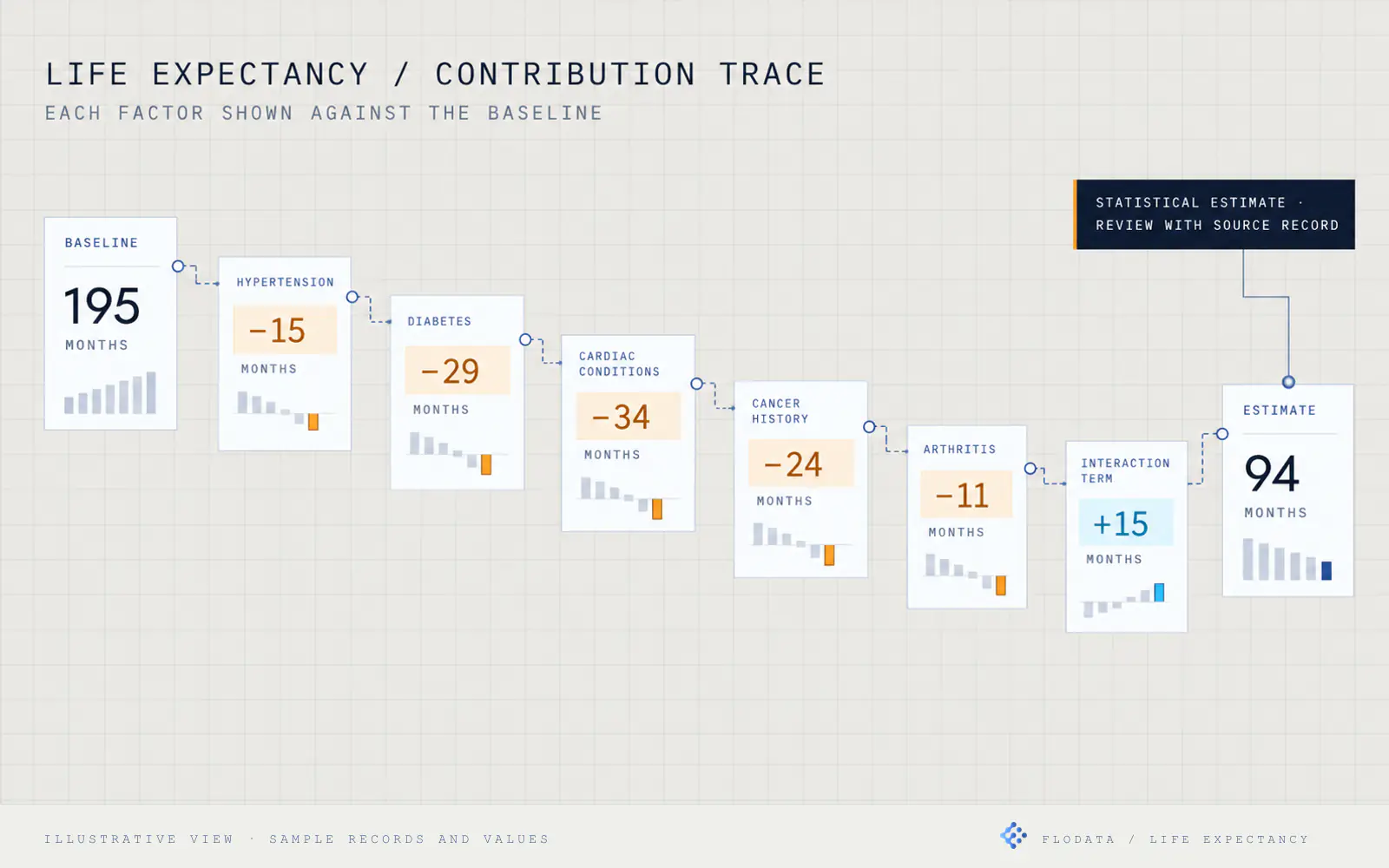
Each modelled factor is shown against the baseline, allowing reviewers to follow the contribution sequence through to the final statistical estimate. Illustrative view using sample records and values.
Compare with existing practice
The supplied case material reports backtesting against an industry benchmark and the client's internal method. It does not provide the accuracy metric, evaluation period, sample size, benchmark dataset or quantitative results, so no numerical performance improvement is claimed.
Keep the estimate reviewable
The contribution view creates a clearer basis for review by connecting the estimate to the factors that influenced it. Supporting source records and unresolved information should remain available to the authorised reviewer when the workflow is implemented operationally.
04 / THE RESULT
A statistical estimate with its reasoning visible.
The workflow connected document extraction, medical-factor standardisation, survival modelling and contribution analysis in one decision surface. Valuation teams could examine the information behind an estimate, understand the direction of each factor's contribution and compare the output with their existing valuation approach. The result was a more structured and explainable input to the life-settlement assessment process.
The supplied material reports comparison with an industry benchmark and the client's existing internal method. The accuracy metric, test period, sample size, benchmark dataset, calibration results and held-out evaluation design are not documented in the available material and require confirmation before publishing a quantified validation claim.
05 / ENGINEERING DETAILUnder the hood
- Medical records — handwritten notes, scanned reports and structured files
- Extract and standardise — OCR, NLP and consistent medical-factor definitions
- Model the estimate — Cox Proportional Hazards survival model
- Explain the contribution — baseline, factor effects and interaction terms
- Support the decision — reviewable output for the valuation workflow
Record preparation. Relevant medical, lifestyle and chronic-condition information is extracted from the available records and converted into consistent analytical fields. The source material should remain traceable so reviewers can inspect the evidence behind an extracted factor.
Model assumptions. The estimate is based on a Cox Proportional Hazards model. Before production use, the proportional-hazards assumption, treatment of censoring, missing information, interaction effects and the stability of the selected factors should be documented and tested.
Clinical and operational review. The output should be treated as a statistical input to valuation rather than a clinical prognosis. The available material does not document independent clinical review, review thresholds, exception handling or the process for challenging an extracted factor or estimate. These controls should be agreed before operational deployment.
Data protection controls. Medical records require clearly defined consent or lawful-processing grounds, role-based access, encryption, audit logging, retention rules and secure deletion procedures. De-identification or pseudonymisation should be applied wherever identifiable information is not required. The supplied material does not document these controls, so they should be confirmed before describing the workflow as production-ready.
- OCR and document classification
- NLP-based medical factor extraction
- Standardised medical and lifestyle factor set
- Cox Proportional Hazards survival model
- Baseline and factor-contribution dashboard
- Benchmark comparison against industry and internal methods